Colors in the Bible
The symbolic use of colors in the Bible is remarkably consistent and precise. Long before colorists vigorously expounded their pet theories about the emotional nature of color, the authors of the 66 books, which form our Bible, used colors with deliberate expertise. Of course, we know that the Holy Spirit was the true author!
Surrounded by our vibrant natural world, we associate particular colors with exclusive emotions. Perhaps it could be argued that we are culturally programmed that way. However, a more apt assessment would be that we are universally designed by God, our Creator, to respond to color in similar ways, whether we reside in Georgetown or Zambia.
When approaching a study of colors in the Bible, I thought that it would be more fun to tie these explorations to either art, poetry, or both together.
Why don’t you participate by using these colors in your own work to evoke similar emotions and infuse your art with symbolism?
Colors in the Bible: RED
In this page we'll examine red, scarlet and crimson, some of the more provocative colors in the Bible. While these three words for the color red are sometimes used in the same sentence in the Old Testament, there seems to be a subtle hierarchy.
Red is common, earthy and ruddy. Red was the color used to describe Esau and David—both vibrant, earthy men known for their impulsive appetites. Ram skins were dyed red and used as a covering for the tabernacle. (Ex 39:34.) A red heifer was required as a sacrifice for cleansing and purification. (Num 19:2)
Red, as a color in the Bible, represents the organic hue of this world – a color reflected in dusty earth and burning fires.
This color is employed to represent the use of objects in the material world to atone for the destructive fires of human sin.
Colors in the Bible: Scarlet & Crimson
The other two colors for red in the Bible, scarlet and crimson, seem to be associated with finer, more expensive materials, like elegant woven, embroidered linen and royal robes. Its deeper, richer hues are synonymous with luxury. These two colors in the Bible described the sumptuously ornamented robes of the priesthood and the tabernacle hangings…
Scarlet and crimson are always used to describe objects of great labor, skill and cost.
When God refers to the cost of sin, scarlet and crimson are His colors of choice.
"Come now, and let us reason together, saith the LORD: though your sins be as scarlet, they shall be as white as snow; though they be red like crimson, they shall be as wool." Isaiah 1:18 KJV
How consistent that our sin, which cost us our fellowship with the Father, should be expressed in the costly colors of scarlet and crimson!
The human authors of the various books of the Bible (a few of which are referred to below), could not have fully comprehended the specific significance of color usage, or the unfolding plan of salvation. Yet they used the precise names of these colors in context with the exactitude of an expert artist. That is rather mind boggling, isn’t it? Unless, of course, another Author was the true mastermind!
Rahab’s cord was scarlet. (Joshua 2:18) It won her and her household salvation, despite her sinful, Gentile heritage.
The wise and confident woman of Proverbs 31 was unafraid of the change of seasons because – you guessed it, her household was clothed in costly scarlet!
Look at how Genesis 38:25-30 describes the outcome of the despicable sinful relationship between Tamar and Judah.
"And it came to pass in the time of her travail, that, behold, twins were in her womb. And it came to pass, when she travailed, that [the one] put out [his] hand: and the midwife took and bound upon his hand a scarlet thread, saying, This came out first. And it came to pass, as he drew back his hand, that, behold, his brother came out: and she said, How hast thou broken forth? [this] breach [be] upon thee: therefore his name was called Pharez." Gen 38:27-29 KJV
This is the same Pharez mentioned in the genealogy of Jesus in Luke 3!
But most precious of all, is the color used in the verse below describing the price that Jesus paid for each of us!
“And they stripped him, and put on him a scarlet robe.” Mat 27:28
The Bible is real history!Conclusion: Colors in the Bible
As an artist, I know that you are acutely aware of harmonious color. When we paint, we make conscious color choices , sensitive to every nuance and variance in the colors. While sometimes intuitive, it is often the result of a good measure of training.
The use of colors in the Bible reflects an unusual and astute knowledge of the subtleties of color. Knowing the diversity of authorship, (some of them as humble as shepherds and nomads) and the grand scope of time that elapsed between the lifetime of these authors, something becomes stunningly apparent.
The indelible imprint of a divine Author becomes undeniable by the clues left behind in the choice of colors in the Bible.
Like a master artist, the Holy Spirit repeats these colors in the Bible with precision, over thousands of years, never using all the reds haphazardly, or interchangeably. His meticulous artistry in word usage is apparent in this incredible book called the Bible, upon which we base our faith.
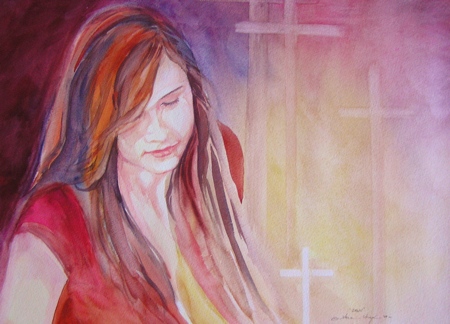
I became interested in the colors of the Bible a long time ago, especially red, scarlet and crimson. The painting above and poem below were done at different times. Do forgive me for my sloppy use of color names, using all the reds interchangeably in word and paint. I wrote this poem long before I did my study. Now I know better!
Red
Strident red in its flashy call
Blared her shameful life to all
Whore to drunks who knew her not
For Rahab of old, red was her lot
That ruby glint hung everywhere
Stubbornly staining its haze in the air
Heard red in voices raised in ire
Felt its painful sting by the night’s fire
Saw hateful red in glances askance
Lust that stripped to lay her bare
Red-tipped also the piercing lance
To dream of escape, she did not dare
But to her surprise, that red it drew
Some braves to her unlike those she knew
They spoke of a God who loved her still
Mightier than gods on the highest hill
Hope throbbed in her in joyous crimson
Though grimly uncertain the battle to win
“Hang a chord in your window in potent red
Gather those you love or they’ll soon be dead”
Her rescue was bound in that chord of red
No longer a hue of disgust or dread
Precious stain of the vibrancy of life
Soothed with peace in the chaos of strife
Had Rahab a clue that many years later
God planned a rescue that was so much greater?
Imagine her joy to discover the role
That red would play in redeeming the soul
Decades thence came flesh of her flesh
His blood it soaked the earth afresh
Restoring hope and erasing our sin
God’s color for redemption is crimson within
© Sara Joseph 2009



2014 Readers' Favorite International Book Award Gold Medal Winner - Christian NonFiction & Illustration
What's New


-
Contemporary Christian Art
 Contemporary christian art: A fresh take on the beloved and familiar Psalm 23.
 -
Grief, Joy and Art
 Grief, Joy and Art is a true story woven around a work of art and a romance born from grief and loss
 -
Pro-life Art
 Pro-life Art: a celebration of life despite its many challenges
 -
Imagination
 Imagination: Biblical truths for creative growth
© Copyright 2008 - 2022 www.christian-artist-resource.com
All rights to written and graphic content reserved. Please do not copy. If you need something, please ask first.